When Systems Don’t Speak: A Patient Left Without Health Coverage
A patient lost his health coverage due to an administrative error. Should citizens navigate complex systems alone, or should systems be designed to guide and protect them?
In my daily work, I occasionally encounter situations that reveal not only individual hardship, but deeper structural weaknesses within our systems.
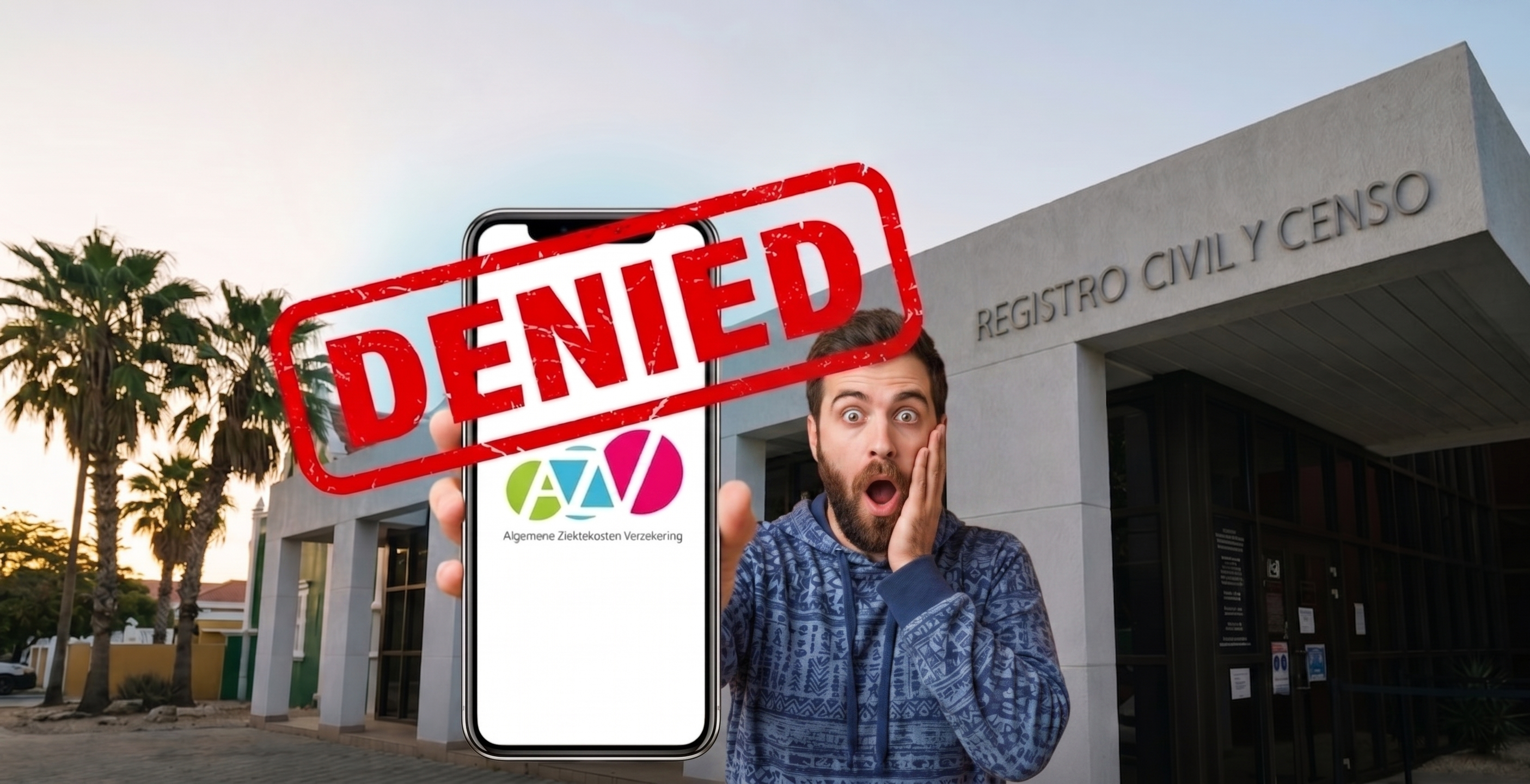
A recent case illustrates this clearly. A man travelled abroad for two months to assist his mother during a period of medical treatment. Upon returning to Aruba, he discovered something entirely unexpected: his registration had been removed from the civil registry by the authorities (ex officio). According to the relevant institution, this had been done under its own authority, based on the assumption that he no longer resided on the island. It was later confirmed to be an administrative error. His parents remained registered. He did not.
Immediate Consequence: Loss of Health Coverage
As a direct result, the patient lost his health insurance coverage under Aruba’s national system. This was not a minor administrative inconvenience. The consequences were immediate and tangible:
- He had to pay for his own medication at the pharmacy
- He lost normal access to healthcare services
- He faced uncertainty and financial pressure
Shortly thereafter, the civil registry authority issued a formal letter confirming the mistake and stating that his registration had been corrected. However, despite this correction, his health insurance coverage had not been restored.
“Everything Has Been Corrected” — But Has It?
When we contacted the civil registry for clarification, the response was clear:
“Nothing is wrong. The issue has already been corrected last week.”
Yet the reality on the ground told a different story. The patient was still paying out of pocket for his medication. Pharmacy receipts confirmed this. The administrative correction had not translated into practical restoration of rights.
The Critical Realization
Following further inquiry, the civil registry contacted the national health insurer.
The response, received a day later, revealed the underlying issue: Re-enrollment in the health insurance system is not automatic.
To be reinstated, the patient was required to:
- Send an email to the insurer’s customer service,
- Provide valid identification.
Without taking this additional step, coverage would not resume.
A Fundamental Question
From the perspective of a citizen and patient, a fundamental question arises:
Is this acceptable?
Should a citizen, who has been removed from the system due to an administrative error and subsequently reinstated, be expected to navigate internal institutional procedures on their own? Particularly when the matter at stake is access to healthcare.
Healthcare Is Not a Technicality
Access to healthcare is not a bureaucratic detail. It is a foundational right. In Aruba, national legislation establishes access to health insurance as a core element of the social system. The Constitution further recognizes the government’s responsibility to promote public health and well-being.
At the international level, the right to health is firmly embedded in legal frameworks such as the International Covenant on Economic, Social and Cultural Rights.
Moreover, from a procedural perspective (art. 2 on the European Convention on Human Rights), the right to life —enshrined in human rights—cannot be meaningfully protected if individuals are effectively excluded from access to healthcare.
In simple terms: Without access to care, the protection of life becomes theoretical rather than real.
More Than an Isolated Case
This situation is not merely an isolated incident. It reveals a structural blind spot. Two institutions operated within their respective mandates:
- One corrected the civil registration.
- The other maintained its own enrollment procedures.
However, the connection between the two was not made visible or actionable for the citizen.
The result: The burden of navigating the system fell entirely on the individual.
Reliance on Chance and Informal Networks
This raises a broader concern. What happens when a citizen does not have access to legal guidance, professional support, or the “right” contact within the system?
In practice, outcomes may depend on:
- The ability to seek legal assistance
- Informal networks or insider knowledge
This introduces inequality into what should be a predictable and accessible public system. There is no single, clear, structured point where such issues can be resolved efficiently.
A System Error With Real Consequences
This is not a minor procedural oversight. It is a system-level failure that:
- Restricts access to healthcare
- Creates unnecessary financial burdens
- Places citizens in vulnerable and uncertain positions
Most importantly, it carries potential consequences for health and safety.
Reasonable Improvements
Addressing this issue does not require complex reform. It requires alignment and awareness.
Three improvements would significantly enhance the system:
1. Clear CommunicationCitizens should be explicitly informed when re-enrollment is not automatic and what steps are required.
2. Soft Coordination Between InstitutionsA simple notification mechanism or procedural linkage between the civil registry and the health insurer could prevent gaps.
3. Human-Centered Service DesignPublic systems should recognize that citizens are not experts in administrative procedures. The system must compensate for this, not assume the opposite.
Recent international experiences—such as the Dutch childcare benefits scandal—have shown the risks of systems that expect citizens to navigate complexity without sufficient guidance.
A Needed Shift in Perspective
Many systems implicitly operate on the assumption:
“The citizen will find the way.”
Reality shows otherwise.
When systems are not transparent and coordinated, citizens do not “find the way”—they bear the consequences.
The necessary shift is simple:
The system should guide the citizen.
Urgency and Proportionality
Even after contacting the health insurer, the standard response indicated a processing time of up to five business days.
While such timelines may be administratively standard, they raise an important question:
Should all requests be treated equally?
A request involving loss of healthcare coverage due to an administrative error is not equivalent to routine administrative processing.
Systems must be capable of differentiating based on risk and urgency. Where access to care is at stake, speed is not a luxury.
It is a form of protection.
Conclusion
This case is not an attack on any single institution. It is an invitation to improve how institutions connect and serve the public.
This is not a failure of one entity, but a missed alignment within the system. From the perspective of the citizen and patient, transitions between institutions should be clearer, simpler, and more reliable.
Governments should not assume that citizens will find their way through complex systems. The system should guide the citizen.
Our societies deserve the next step: A system that is not only efficient, but also humane, transparent, and dependable for all.
Now what?
If this situation feels closer than it should, the next step is not to wait until something goes wrong, but to understand where you stand before it does.
Do you know what happens if your registration changes? Whether your health coverage continues automatically? Who you need to contact—and when? These are not technical details. They are the difference between access and uncertainty.
Start small: check your status, ask questions when something is unclear, and do not assume the system will guide you without your input.
If you want to go further—understanding your rights as a patient, how systems like AZV work in practice, and what to do when they don’t—I’ve brought this together in my book E derechonan di pashent. It is written as a practical guide to help you navigate real situations with clarity, so you are not left depending on chance when it matters most.
Get your copy at Plaza Bookshop or order it directly here: